
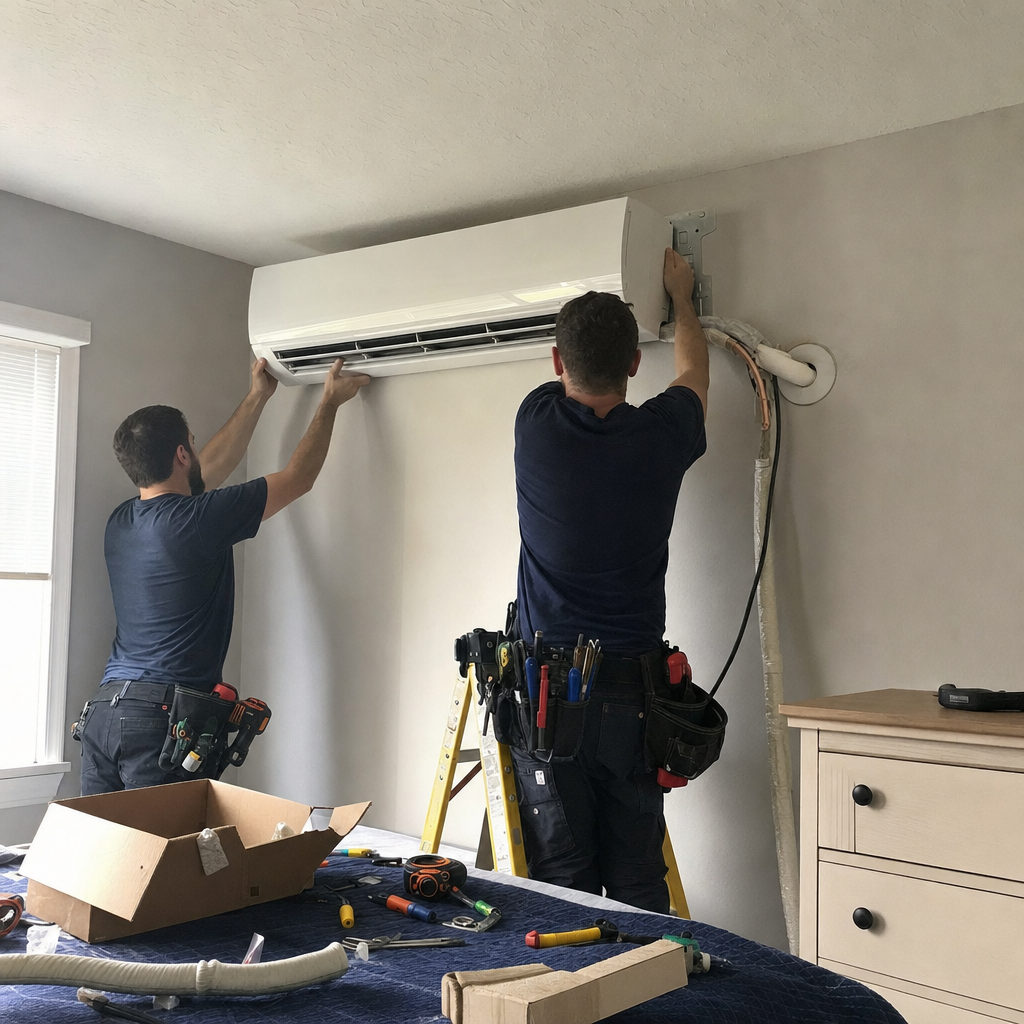
Why Is My AC Blowing Warm Air in Lancaster, PA?
The most common reason your AC is blowing warm air is a refrigerant leak or a frozen evaporator coil, both of which stop the system from absorbing heat from your home’s air. In Lancaster’s humid summer climate, where the Susquehanna Valley traps heat and pushes cooling loads higher than regional averages, these failures often show up first as weak airflow that gradually turns warm. Most of the calls we take at (866) 561-3358 start exactly this way: the homeowner notices the vents aren’t cool by mid-afternoon, when the system has been running hard since morning.
We’ve been tracking these patterns across Lancaster County since 1984. Glen Hartman, our owner, trained at Thaddeus Stevens College of Technology right here in Lancaster and has spent four decades crawling through attics in Cabbage Hill row houses and post-war ranch homes beyond the city limits. The geography matters. Lancaster sits in a bowl between South Mountain and the Susquehanna uplands, which traps humidity and forces air conditioners to work harder than identical units installed in York or Harrisburg. That extra strain means components fail differently here, and they fail sooner if maintenance gets skipped.
What Warm Air Actually Tells You: Reading the Symptoms
Not all warm-air calls are the same problem. The temperature coming from your vents, the timing of when it started, and what your outdoor unit is doing all point to different failures. Here’s how we sort them when a Lancaster homeowner calls.
| What You’re Feeling | Most Likely Cause | Typical Repair Range |
|---|---|---|
| Room-temperature air, weak airflow | Frozen evaporator coil or clogged filter | $150-$350 |
| Air starts cool, turns warm after 20 minutes | Low refrigerant from leak | $200-$650 |
| Warm air, outdoor unit not running | Compressor failure or electrical issue | $250-$650 |
| Warm air, outdoor unit running constantly | Reversing valve stuck (heat pump) or bad capacitor | $150-$450 |
The frozen coil is the one we see most often in Lancaster’s older housing stock. In the city’s pre-1940 brick row homes, narrow floor plates and plaster walls mean many systems were retrofitted with ductwork that restricts airflow more than a home built for forced air. Reduced airflow across the coil drops its temperature below freezing, ice builds up, and suddenly you’re circulating warm, humid air instead of cool, dry air. We’ve pulled frozen coils out of Cabbage Hill attics in July that looked like solid blocks of ice.
Refrigerant leaks tell a different story. Modern systems use R-410A or the newer R-32, and both operate at higher pressures than the old R-22 systems still running in some county farmhouses. A pinhole leak in a line set, often where it rubs against a basement joist or passes through limestone foundation walls, bleeds refrigerant slowly. The system runs longer, works harder, and eventually can’t transfer enough heat to produce cold air. Our technicians carry electronic leak detectors and nitrogen purge rigs on every truck, and most leaks we find in Lancaster homes are repairable without replacing the full line set.
Three Checks Before You Call - and When to Stop
There are a few things any homeowner can safely verify. Beyond these, the risks of DIY work on a pressurized refrigerant system or high-voltage electrical components aren’t worth it, and federal law requires EPA certification to handle refrigerant.
- Check your thermostat setting. Someone switched to “Heat” or “Fan Only” more often than you’d think. Verify it’s on “Cool” and the set point is below room temperature.
- Replace or inspect your filter. A clogged filter is the single most common cause of restricted airflow and frozen coils. In Lancaster, where pollen counts spike hard in late spring and limestone dust is a year-round factor, we see filters choked far earlier than the 90-day recommendation.
- Look at your outdoor unit. Is the fan spinning? Is the area around it clear of weeds, mulch, or debris? A unit buried in last fall’s leaves can’t reject heat.
If you’ve done these three things and the air is still warm, the problem is inside the sealed refrigeration circuit or the electrical controls. That’s when we come in. Our technicians are trained on nine major brands including Goodman, Rheem, and York, and they carry the diagnostic tools to pinpoint whether you’re looking at a $200 capacitor or a compressor heading toward replacement.
Why Lancaster’s Climate and Housing Make This Trickier
The local conditions we work in aren’t theoretical. Lancaster’s summer humidity, combined with that valley heat trap, means evaporator coils run wet for months. The condensate drain pan and line are working overtime, and algae growth in those lines is common enough that we clear blocked drains weekly during July and August. A backed-up drain triggers a float switch that shuts the indoor unit down, but the outdoor compressor keeps running, so you get warm air and a puzzled homeowner.
Beyond the city, in the county’s 18th- and 19th-century farmhouses and post-war ranches on well and propane, we see a different pattern. Natural gas thins out quickly past the city limits, so many homes run heat pumps or straight electric cooling. A stuck reversing valve on a heat pump, confused by a faulty defrost board, will dump heat into your ducts even in cooling mode. Diagnosing that requires understanding both the refrigeration cycle and the control logic, which is why our journeyman technicians train continuously on Daikin and other variable-speed systems that are increasingly common in rural Lancaster County retrofits.
The limestone karst geology here also matters in ways most homeowners don’t expect. Hard water scale builds up in whole-house humidifiers attached to furnaces, and in boiler systems that share ductwork or hydronic coils with cooling. Scale restricts water flow, reduces heat transfer, and can trick a system into running inefficiently enough that cooling capacity drops. We’ve replaced humidifier pads in Lancaster basements that were cemented solid with mineral deposits.
What Repair Actually Costs - and What “Cheap” Gets You
We quote every job upfront, and the price we quote is the price you pay. For AC repair in Lancaster, most warm-air calls fall between $150 and $650, depending on what’s failed. A simple capacitor replacement or contactor swap sits at the low end. A refrigerant leak search, repair, and recharge runs higher. Compressor replacement or a full indoor coil changeout pushes toward the top of that range and sometimes beyond, at which point we have the straight talk about repair versus replace.
Our current standing offers include $50 off any repair over $250, and we always provide free second opinions on any written estimate you’ve received elsewhere. The $89 seasonal tune-up catches most of these problems before they strand you on a Saturday afternoon when the humidity is thick enough to cut.
We also honor a permanent 5% discount for seniors and veterans. No paperwork to file, no expiration date. It’s applied at the time of service.
FAQs
Most repairs run between $150 and $650, with simple fixes like capacitors or contactors at the lower end and refrigerant leak repairs toward the higher end. The exact cost depends on which component failed and how accessible it is in your particular home. Call (866) 561-3358 for a free, no-pressure estimate with upfront pricing.
You can check three things safely: thermostat settings, the filter, and whether your outdoor unit is running and clear of debris. Beyond that, AC systems contain high-voltage electricity and pressurized refrigerant, and federal law requires EPA certification to handle refrigerant. We recommend calling a trained technician rather than risking injury or system damage.
If your system is over 12 years old, uses phased-out R-22 refrigerant, or has needed multiple repairs in two years, replacement often costs less over time than continued patchwork. We size systems honestly, no upsell, and we’ll walk you through the math both ways. Our 90-Day Done Right Promise applies either way, in writing, with no arguing.
A live person answers our phones 24 hours a day, 7 days a week, including holidays. Most repairs are completed in a single visit because our trucks are stocked with parts for Goodman, Rheem, York, and the other major brands we service. Same-day appointments are available when you call (866) 561-3358.
When You’re Ready to Stop Guessing
Warm air from your vents is your system telling you something specific. The question is whether you’re hearing the right message. We’ve spent 42 years learning to translate those signals in Lancaster’s particular climate, in its row houses and farmhouses and everything between. Tell me what your system is doing, and I’ll tell you what it needs. That’s the whole conversation.
If you’d rather have it looked at, Fireside Heating & Air Co. offers a no-pressure assessment in Lancaster. Call (866) 561-3358.
Written by Glen Hartman, Owner, Fireside Heating & Air Co. at Fireside Heating & Air Co., serving Lancaster, PA.