
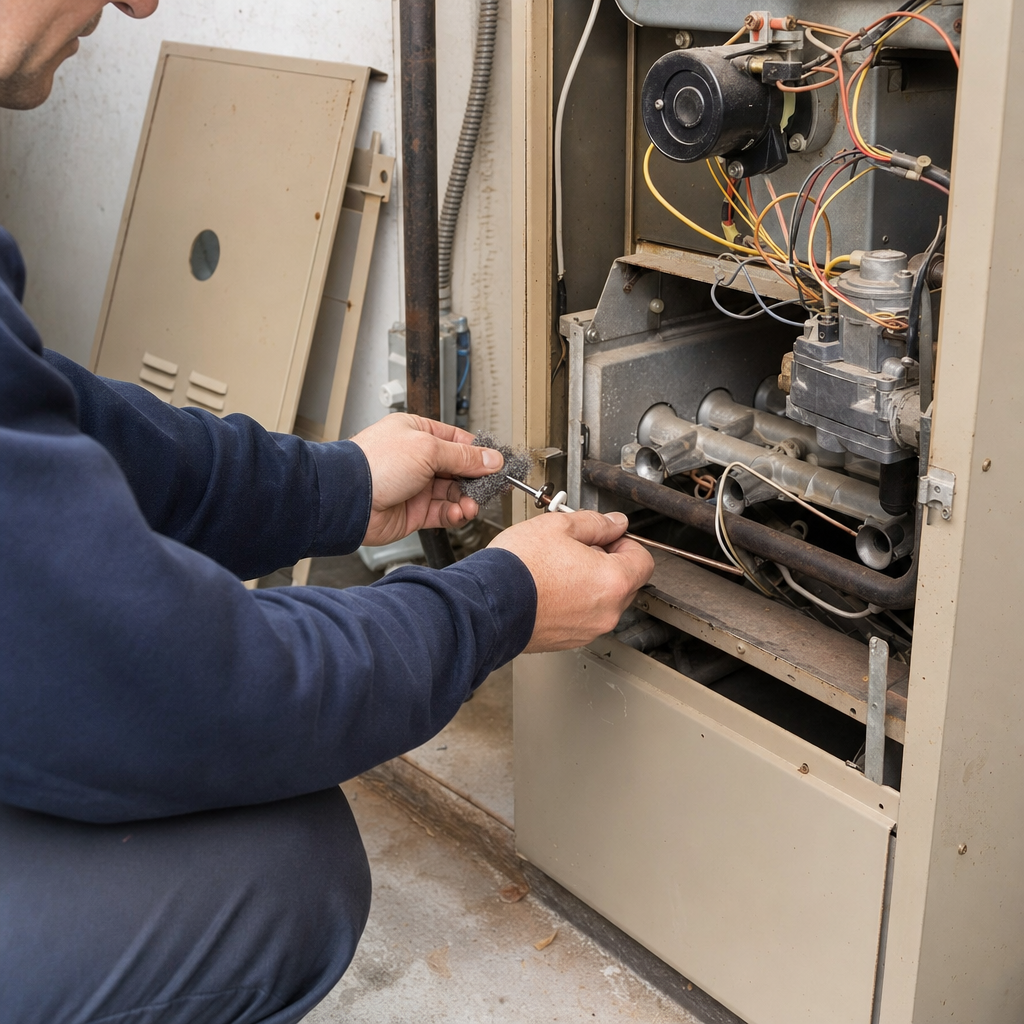
Why Is My AC Not Turning On in Lancaster, PA?
The most common reason an AC won’t turn on is a tripped circuit breaker or blown fuse, followed by a faulty thermostat or clogged condensate drain switch. In Lancaster’s row-home neighborhoods, we also see a lot of systems that simply can’t handle the heat load trapped in the city’s geographic bowl. If your unit won’t start, check your electrical panel first, then your thermostat batteries. If neither fixes it, call Fireside Heating & Air Co. at (866) 561-3358 - we’ll send a technician who knows Lancaster housing stock, not a script reader.
What We Find Most Often in Lancaster Homes
After 42 years of answering no-cool calls across Lancaster County, we’ve learned that “won’t turn on” covers about a dozen different failures. Some are simple. Some aren’t. Here’s what our technicians check first, and what we typically find.
The Electrical Culprits
Power problems top the list everywhere, but Lancaster’s older housing makes them more interesting. In the city’s pre-1940 brick row homes, original electrical panels were never designed for modern AC loads. We’ve seen 100-amp services struggling to start a 3-ton condenser on a 95-degree July afternoon, especially in Cabbage Hill and the Southeast quadrant where the urban heat island effect pushes temperatures several degrees above the county average.
- Tripped breaker or blown fuse: The compressor’s start-up surge can trip a weak breaker, especially if the panel is original or has been “upgraded” piecemeal over decades.
- Disconnected or burnt wiring: Lancaster’s limestone geology produces hard water and, in some areas, slightly corrosive soil conditions that can degrade outdoor disconnect boxes faster than you’d expect.
- Bad capacitor: The capacitor gives your compressor the kick it needs to start. When it fails, you’ll often hear a humming noise but the unit won’t run. In Lancaster’s humid summers, capacitors work harder and fail sooner than in drier climates.
Capacitor replacement typically runs $150-$340. If the compressor itself has failed, you’re looking at the higher end of our $150-$650 repair range, and sometimes replacement makes more sense.
Thermostat and Control Issues
We get a fair number of calls where the AC “won’t turn on” because the thermostat is set to heat, or the batteries died, or a grandchild bumped the programming. We don’t charge for those calls - we just fix it and move on. But we also see plenty of failed control boards, especially on systems that have cycled heavily through Lancaster’s humid summers and hard winters.
Modern thermostats with Wi-Fi connectivity add another layer. In Lancaster’s older homes with plaster-and-lath walls, Wi-Fi signals can be weak where the thermostat mounts, causing intermittent communication failures that look like the AC won’t start.
The Condensate Safety Switch
This one’s worth knowing about. Your AC removes humidity from the air, and that water has to go somewhere. If the drain line clogs - and in Lancaster, algae and mold grow aggressively in dark, humid condensate lines - a safety switch will shut the entire system down to prevent water damage. The system isn’t broken. It’s protecting your home. Clearing a condensate line and resetting the switch is usually a quick, lower-cost repair.
Refrigerant and Compressor Failures
If your system hums but won’t start, or starts briefly then shuts off, you may have a refrigerant leak or compressor issue. Lancaster’s heavier cooling loads, driven by the valley’s heat-trapping geography, mean compressors here work harder than in higher-elevation communities. A system that might last 15 years in York County can show wear sooner in Lancaster City.
We’re trained on nine major brands including Carrier, Trane, Lennox, Daikin, Bryant, and American Standard, so we can diagnose properly without guessing.
When Lancaster’s Housing Stock Makes AC Problems Different
Here’s where this gets locally specific, and where a lot of generic HVAC advice falls short.
Lancaster City’s core neighborhoods - Cabbage Hill, Southeast, downtown - are dominated by 2-3 story brick row homes built between 1880 and 1945. These houses were designed for coal or oil-fired steam heat. They have no ductwork. Zero. When we get a “no AC” call from one of these homes, the system is almost certainly a ductless mini-split or a high-velocity retrofit, and the failure points are different from standard forced-air systems.
In row homes with original one-pipe steam boilers still running, we’ve seen homeowners confuse the boiler’s failure with an AC problem - especially in spring and fall when both systems might get used in the same week. The radiators are cast iron, often painted over for a century, and the steam vents have their own quirks that can look like HVAC trouble to someone who hasn’t worked on them before.
Outside the city, Lancaster County’s 18th-19th century farmhouses and post-war ranches present their own issues. Many rural properties are on well water and propane, since natural gas thins out quickly beyond city limits. Hard water from the limestone karst geology accelerates scale buildup in boilers, humidifiers, and even some condensate pumps. A “won’t start” call in a farmhouse outside Ephrata or Lititz often involves different components than the same call in the city.
We’ve also worked around historic preservation guidelines that prohibit exterior penetrations or visible line sets on front facades. Installing or servicing AC in these homes requires creativity that template-trained techs simply don’t have.
What You Can Safely Check Yourself
We’re not going to tell you to open electrical panels or charge refrigerant. That’s how people get hurt. But there are a few things any homeowner can check before calling:
- Check your thermostat: Is it set to COOL? Is the temperature setting below room temperature? Are the batteries fresh?
- Check your electrical panel: Look for a tripped breaker. If the AC breaker is tripped, flip it fully OFF, then back ON. If it trips again, stop and call us - there’s a real electrical problem.
- Check the outdoor unit: Is the disconnect switch in the ON position? Is debris blocking the condenser? (Leaves, mulch, grass clippings - we see it all.)
- Check for water around the indoor unit: A full condensate pan means the drain is clogged and the safety switch has done its job.
If none of these solve it, the problem is inside the system, and that’s where our training matters. We’ve been doing this since 1984. Glen Hartman started this company after training at Thaddeus Stevens College of Technology right here in Lancaster, and he’s spent four decades learning what fails in local homes and why.
What AC Repair Costs in Lancaster
We believe in upfront pricing. The price we quote is the price you pay. No surprises, no add-ons after we start.
| Service | Typical Range in Lancaster |
|---|---|
| Standard AC repair (capacitor, contactor, fuse, etc.) | $150-$340 |
| Complex AC repair (compressor, control board, refrigerant leak) | $340-$650 |
| Full AC installation (if replacement makes sense) | $3,500-$7,500 |
| Seasonal tune-up (prevents most no-start problems) | $89 |
We offer $50 off any repair over $250, and our $89 seasonal tune-up catches most of these problems before they leave you sweating on a Saturday night. Seniors and veterans always receive 5% off.
Every repair is backed by our 90-Day Done Right Promise - in writing, no paperwork to file, no arguing. If it’s not right, we make it right.
FAQs
If your thermostat has power but the AC won’t start, the problem is almost always a tripped breaker, failed capacitor, or triggered condensate safety switch. Check your electrical panel and look for water around your indoor unit. If those look normal, the capacitor or contactor likely needs replacement - call (866) 561-3358 and we’ll diagnose it properly.
Most no-start repairs in Lancaster run $150-$650, with simple electrical fixes at the lower end and compressor or control board issues at the higher end. We quote upfront before any work begins, and we offer $50 off repairs over $250. Call for a free estimate - there’s no charge for us to look and tell you what’s wrong.
You can safely check your thermostat settings, breaker panel, and outdoor disconnect switch. Beyond that, AC systems involve high voltage and pressurized refrigerant - both dangerous without proper training. In Lancaster’s older homes, the electrical setup can be especially unforgiving. We recommend calling a professional rather than risking injury or making the problem more expensive to fix.
A live person answers our phones 24 hours a day, 7 days a week, including holidays. For no-cool calls in summer, we typically schedule same-day or next-day service across Lancaster County. We’ve been here 42 years - we’re not going to leave you waiting when it’s 92 degrees and humid.
When Replacement Makes More Sense Than Repair
Sometimes we show up and the news isn’t what anyone wants to hear. The compressor is seized. The refrigerant is obsolete. The system is 22 years old and every major component is failing in sequence.
We don’t soft-pedal this, and we don’t upsell. We give you straight talk about repair versus replace, with real numbers for both options. If your system is over 15 years old and the repair estimate approaches $1,500, we’ll show you what a new AC Repair & Installation in Lancaster would cost and let you decide. No pressure. The price quoted is the price paid.
We’re trained to size systems honestly - no equipment you don’t need. That’s especially important in Lancaster’s row homes, where a too-large system will short-cycle and fail early, and a too-small one will never keep up on the hottest August afternoons.
Call Fireside When Your AC Won’t Start
If your air conditioner won’t turn on and you’ve checked the basics, we’re here. A live person will answer when you call (866) 561-3358, day or night. We’ll send a background-checked, uniformed technician who puts on shoe covers without being asked and treats your home like their mother’s.
We’ve served Lancaster County since 1984. Most repairs are completed in a single visit. And everything we do is backed in writing - the 90-Day Done Right Promise, no arguing, no paperwork.
Written by Glen Hartman, Owner, Fireside Heating & Air Co. at Fireside Heating & Air Co., serving Lancaster, PA.