
How to Improve Indoor Air Quality in Lancaster, PA
The fastest way to improve indoor air quality in Lancaster is to match the solution to your home’s heating system: if you have forced air, upgrade to a MERV 13 filter and seal your ductwork; if you have steam radiators or a boiler with no ductwork, install standalone filtration, a whole-house dehumidifier, or a ductless mini-split with integrated air cleaning. Most Lancaster City row homes fall into the second category, and the generic advice to “change your filter” simply doesn’t apply. Call (866) 561-3358 for a free IAQ assessment and we’ll tell you what your specific system needs.
If Your Lancaster Home Has Steam Heat, You Don’t Have a Filter to Change
Here’s something the big-box store guides never mention: in Lancaster’s pre-1940 brick row homes, especially neighborhoods like Cabbage Hill and the Southeast quadrant, one-pipe steam and hot-water radiator systems circulate exactly zero air. No blower. No return duct. No central filter. The heat rises by convection, warms the room, and that’s the whole process.
We’ve walked into homes where the homeowner has been running a portable HEPA unit in the living room for three years, wondering why the upstairs bedrooms still smell musty. The answer is simple: steam heat moves no air between rooms. Dust, mold spores, pollen, and humidity imbalances go completely unaddressed by standard filtration advice because there’s no pathway for that advice to travel.
Glen Hartman, who grew up in Cabbage Hill and trained at Thaddeus Stevens College of Technology right here in Lancaster, puts it plainly: “Tell me what your system is doing, and I’ll tell you what it needs. That’s the whole conversation.” For steam-heated homes, what the system is doing is heating without ventilating. That means any air quality solution must be engineered from scratch around your home’s actual construction.
What Actually Works for Steam and Boiler Homes
- Standalone HEPA air purifiers sized per room, not one unit trying to cover a whole floor
- Whole-house dehumidifiers with dedicated ducting or drain lines, since Lancaster’s bowl geography traps summer humidity against plaster walls
- Energy Recovery Ventilators (ERVs) that bring in fresh outdoor air without dumping your heat in January
- Ductless mini-split systems with integrated filtration, which also solve the cooling problem in homes with no existing ductwork
Our Air Quality & Ventilation team assesses these factors on every call. We don’t sell equipment; we size solutions.
Lancaster’s Hard Water Is Quietly Ruining Your Humidifier
This is the local detail almost no IAQ guide mentions. Lancaster sits on limestone karst geology, and our water is notably hard. That matters because whole-house humidifiers attached to boilers and steam systems accumulate mineral scale at an accelerated rate. We’ve opened units that looked like they were filled with gravel.
That scale isn’t just an efficiency problem. It creates a breeding environment for bacteria if the unit isn’t descaled on a precise schedule. Most manufacturer recommendations assume average water hardness. Lancaster’s water laughs at average. We descale on a shorter interval, and we document it in our logbooks so there’s no guessing.
For homeowners with steam systems considering humidification, we often recommend standalone steam or evaporative units with replaceable canisters rather than flow-through models that scale up and become biological hazards. The upfront cost runs higher, but the maintenance is honest and the air quality is actually controlled.
Ductless Mini-Splits: Your Filter Is the Only Mechanical Filtration in the House
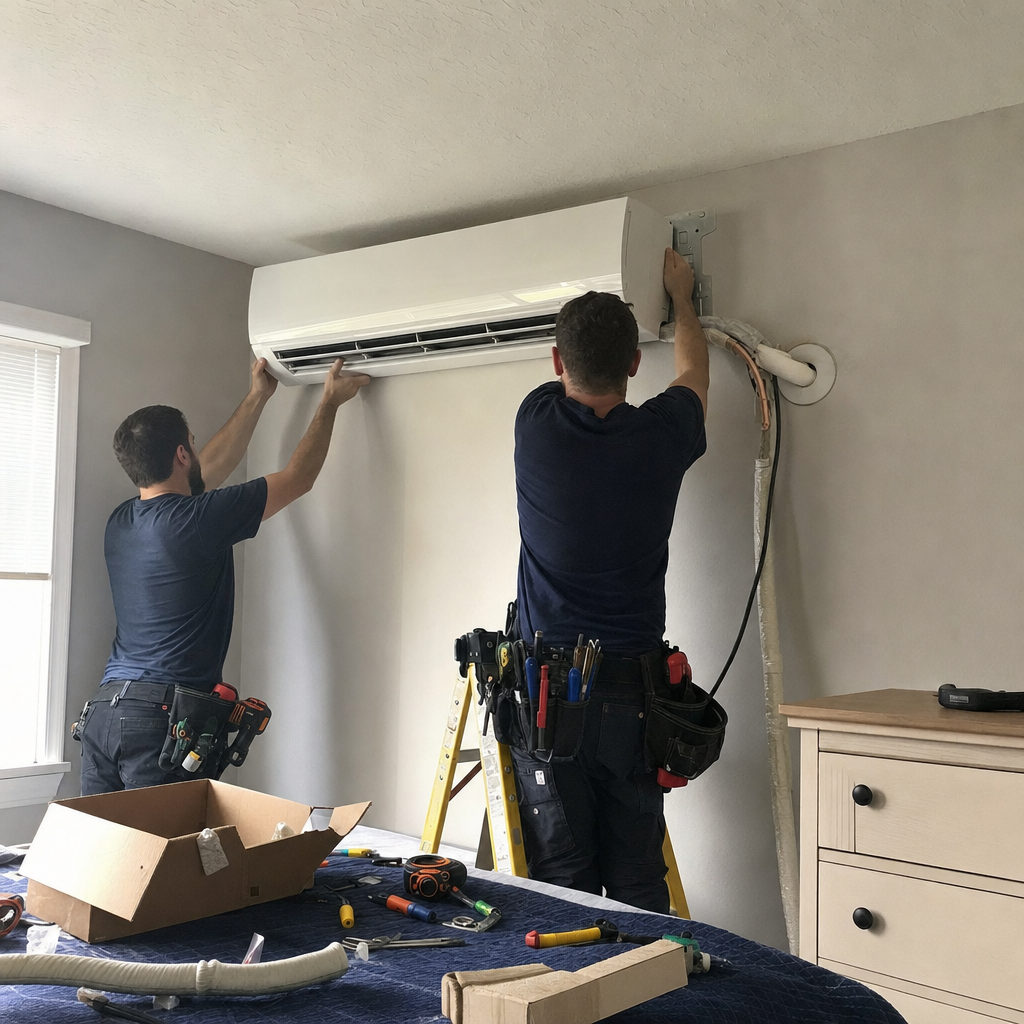
In Lancaster row homes where we’ve installed ductless mini-splits for cooling, there’s a critical maintenance detail that generic schedules get wrong. The wall-cassette filter is the only mechanical filtration point in the entire house. In a forced-air home, you’ve got a central filter, maybe a media cabinet, maybe a UV light. In a ductless home, you’ve got a mesh screen the size of a paperback book.
During heavy-use seasons, that filter needs cleaning every two to four weeks, not semi-annually. Lancaster’s summer humidity and pollen load clog it faster than manufacturer guidelines suggest. A dirty mini-split filter restricts airflow, strains the compressor, and circulates unfiltered air. We show every homeowner how to do it, and we check it on every seasonal tune-up.
Some ductless systems from brands like Lennox and Daikin offer optional plasma or ionization add-ons. We evaluate whether those make sense for your specific layout, not as an automatic upsell.
What Fireside’s IAQ Assessment Actually Covers
Every service call our technicians make in Lancaster includes a baseline IAQ assessment. We check humidity levels, look for condensation patterns on windows and plaster, identify whether your home has positive or negative pressure, and note any musty odors or visible mold. If you want a deeper evaluation, we offer dedicated air quality testing with specific recommendations.
Our technicians are trained on nine major brands including Lennox, Goodman, Rheem, and York, and they carry options for point-of-use purifiers, standalone ERVs, and ductless-integrated filtration. Everything we recommend is backed by our 90-Day Done Right Promise - if it’s not done right, we make it right, in writing, with no paperwork and no arguing.
| Service | Typical Range in Lancaster |
|---|---|
| IAQ Assessment with Service Call | No additional charge |
| Standalone HEPA Purifier (per unit, installed) | $400-$900 |
| Whole-House Dehumidifier (standalone, ducted) | $2,200-$4,500 |
| ERV Installation | $3,500-$6,500 |
| Ductless Mini-Split with Filtration (single zone) | $3,500-$5,500 |
| Seasonal Tune-Up | $80-$200 |
Pricing is upfront: the price quoted is the price paid. We also honor a permanent 5% discount for seniors and veterans, and we currently offer $89 seasonal tune-ups and $50 off any repair over $250.
Step-by-Step: What to Check Before You Call
- Identify your heating system type. Look at your radiators or basement mechanicals. Steam pipes? Boiler with circulating pump? Forced-air furnace with ductwork? This determines every solution that follows.
- Check your humidity. A simple hygrometer costs $15. In Lancaster, winter humidity below 30% causes respiratory irritation; summer humidity above 60% invites mold. Steam-heated homes often swing wildly between both.
- Look for condensation. Windows that weep in winter, plaster that darkens near baseboards, or a persistent musty smell in basement or first-floor rooms signals moisture control problems that filtration alone won’t fix.
- Note any portable units you’re already running. If you’ve got multiple HEPA purifiers and still have symptoms, the issue is likely ventilation, not filtration.
- Call for an honest assessment. We’ll tell you what’s worth doing and what isn’t. No equipment you don’t need.
Key Takeaways
- Lancaster’s pre-1940 row homes with steam or boiler heat have no central filtration pathway - standard advice doesn’t apply
- Hard karst water accelerates scale in humidifiers, requiring local-specific maintenance schedules
- Ductless mini-split filters need cleaning every 2-4 weeks in heavy seasons, not twice yearly
- Whole-house dehumidification and ERVs must be engineered as standalone systems when no ductwork exists
- Fireside’s IAQ assessment is included with every service call, with solutions sized to your home’s actual construction
FAQs
Basic improvements like standalone HEPA purifiers run $400-$900 per unit installed, while whole-house solutions like ERVs or dehumidifiers typically range from $2,200-$6,500 depending on your home’s layout and whether ductwork exists. Steam-heated Lancaster row homes often need creative standalone solutions rather than simple filter upgrades. Call (866) 561-3358 for a free estimate - we’ll quote upfront pricing with no pressure.
For scale-damaged whole-house humidifiers in Lancaster, replacement is usually more cost-effective than repair because our hard water will simply destroy the new components on the same accelerated timeline. We typically recommend replaceable-canister steam units or bypass evaporative models with honest maintenance access. Every recommendation comes with our 90-Day Done Right Promise.
Yes - in fact, about half of Lancaster City’s housing stock has no existing ductwork, and we’ve been designing standalone dehumidification, ERV, and ductless mini-split solutions for these homes for over 42 years. The equipment exists; it just requires a contractor who understands hydronic heating and historic construction constraints.
We answer our phones live, 24 hours a day, 7 days a week, including nights and holidays. Most non-emergency assessments are scheduled within 24-48 hours, and emergency situations get same-day response. When we say we’ll be there, we’ll be there.
If you’d rather have it looked at, Fireside Heating & Air Co. offers a no-pressure assessment in Lancaster - call (866) 561-3358.
Written by Glen Hartman, Owner, Fireside Heating & Air Co. at Fireside Heating & Air Co., serving Lancaster, PA.