
High Energy Bills
What’s Happening
A sudden or steady rise in your heating and cooling bills almost always means your HVAC system is working harder than it should to hold the temperature you’ve set. The most common causes are a dirty or failing component, a refrigerant problem, or a system that has aged past the point where it runs efficiently. In most cases, a trained technician can pinpoint the cause in a single visit and tell you exactly what it will cost to fix before any work begins.
Your thermostat hasn’t changed. Your habits haven’t changed. But the bill has, and it keeps climbing. That gap between what your system should cost to run and what it actually costs is almost always mechanical – something is making the equipment work two or three times longer than it needs to in order to move the same amount of heat or cold air through your home. Left alone, that strain compounds: a dirty coil forces the compressor harder, a weak capacitor causes the motor to drag, and the meter keeps running. The good news is that most of the causes below are fixable, and fixing them tends to drop the bill noticeably within the next billing cycle.
Why It Happens
A Dirty or Clogged Air Filter and Coil
This is the single most common reason a system’s efficiency drops quietly over time. When the air filter is clogged, the blower motor strains against restricted airflow, running longer to move the same volume of air. If that goes on long enough, the evaporator coil behind the filter can ice over or coat with dust, which cuts heat transfer dramatically. Pull your filter out right now: if you can’t see light through it, that’s your first clue.
Low or Leaking Refrigerant
Refrigerant doesn’t “run low” the way gas runs out of a tank – if it’s low, that means there’s a leak somewhere in the system. A system running short on refrigerant has to cycle much longer to reach your set temperature, and in some cases it never quite gets there. Signs homeowners often notice first: the air coming from the vents feels less cold than it used to, or the outdoor unit runs almost constantly even on a mild day.
A Failing Capacitor or Contactor
Capacitors give the compressor and fan motors the jolt they need to start up cleanly. When a capacitor is weakening, motors drag on startup and draw extra current every cycle. You might hear a faint hum or clicking near the outdoor unit right before it kicks on, or notice the system takes a few seconds longer to start than it used to. This is a relatively inexpensive repair, but the extra electrical draw it causes is not inexpensive on your bill.
An Aging System Running Past Its Efficient Years
Most heating and cooling equipment runs at its rated efficiency for the first ten to fifteen years with proper maintenance. After that, wear accumulates – heat exchangers lose some of their transfer capacity, compressors work harder, and the system’s real-world efficiency drifts well below what the nameplate says. If your equipment is fifteen or more years old and the bills have been creeping up for two or three years, that’s a pattern worth discussing with a technician rather than just chasing repairs.
What to Do Right Now
- Check and replace the air filter. Find your return air vent (usually a large grille on a wall or ceiling, or near the air handler), pull the filter, and hold it up to a light. If it’s gray and dense, replace it before the technician arrives – it takes two minutes and costs almost nothing.
- Look at your outdoor unit. Make sure grass, shrubs, or debris aren’t crowding the sides or top of the unit. A few inches of clearance on all sides matters. Do not remove any panels or touch any electrical components inside the unit – capacitors and contactors hold a charge even after the power is off and can cause a serious shock.
- Check your thermostat settings. Make sure the fan is set to “Auto” rather than “On.” A fan running continuously on “On” moves air without conditioning it, which inflates the bill without adding comfort.
- Note when the system runs. Before you call, spend an hour paying attention: does the outdoor unit run almost continuously, or does it cycle on and off normally? Does the air from the vents feel noticeably less cool or warm than usual? Write it down – this information helps the technician narrow things down faster on arrival.
- If you smell gas or see ice on the refrigerant lines, stop using the system and call immediately. Ice on the lines can indicate a refrigerant or airflow problem that will worsen quickly. A gas smell near a furnace is a different matter entirely – shut off the system, don’t operate any switches, and call from outside.
How We Fix It
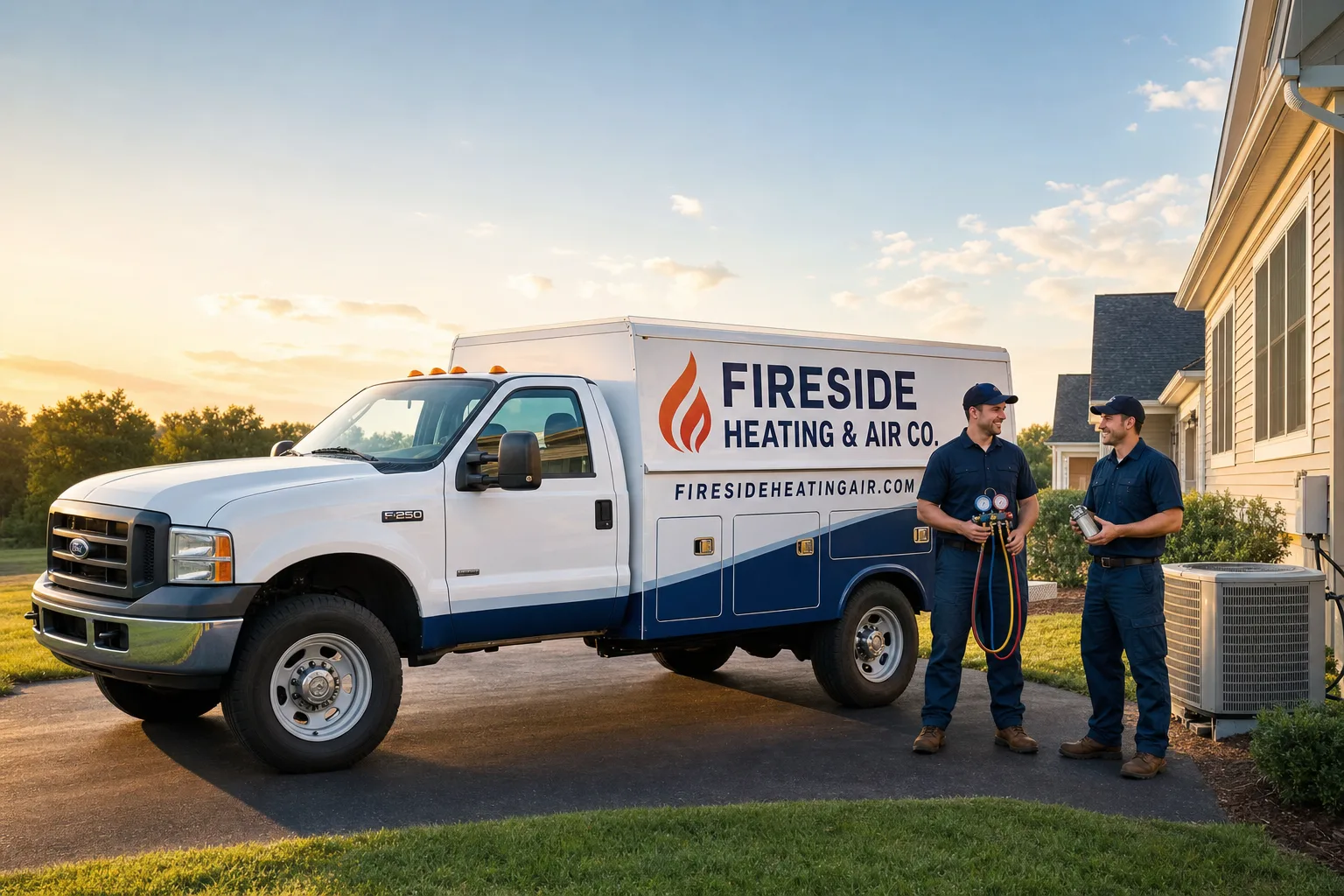
When a Fireside Heating & Air Co. technician arrives, the first thing they do is listen to you – what you’ve noticed, how long it’s been happening, what changed. Then they run a full diagnostic: airflow measurements, refrigerant pressure readings, capacitor tests, and a visual inspection of the heat exchanger and coil. Most of the causes listed above show up clearly in that diagnostic.
Before any repair starts, you get a written estimate with the exact price. That’s the price you pay – no surprises on the bill. Our 90-Day Done Right Promise covers the work: if something isn’t right within 90 days, we come back and make it right. No paperwork, no arguing.
Depending on what the diagnostic shows, the repair path usually falls under our AC Repair & Installation or Heating & Furnace service, and most jobs are completed in a single visit. If efficiency is the primary issue and no hard repairs are needed, an $89 Seasonal Tune-Up will cover a full cleaning, coil inspection, and system check. We’re also trained to service Carrier, Trane, Lennox, Goodman, Rheem, York, Daikin, Bryant, and American Standard – so whatever’s in your mechanical room, we know it.
Frequently Asked Questions
Usually not immediately dangerous, but sometimes yes. A cracked heat exchanger on a gas furnace, for example, will reduce efficiency and can allow combustion gases into your living space – that’s a safety issue, not just a cost issue. If your bills are rising and you’re also noticing headaches, stale air, or a faint smell near the furnace, don’t wait. Call (866) 561-3358 and let someone take a look before the next heating cycle.
That depends entirely on what the diagnostic finds, and we won’t know until we look. What we will tell you is that every job starts with a free written estimate – the price in writing, before anything starts. There are no surprises on the bill at Fireside. Call (866) 561-3358 to schedule a diagnostic and get your number in writing.
Most of the causes behind high bills don’t fix themselves – they get worse over time and pull more current the longer they run in a degraded state. A weak capacitor that’s doubling your run cycles today can fail completely next week, turning a repair into an emergency on a Saturday night. It’s worth a call now. Reach your local Fireside Heating & Air Co. team at (866) 561-3358 – someone answers every hour of every day, including weekends and holidays.
Your local Fireside Heating & Air Co. team works to get to you as quickly as possible, and our phones are answered by a live person around the clock – not a voicemail tree. Call (866) 561-3358 right now and a real person will tell you exactly when we can be there.
Get It Fixed
Call (866) 561-3358 any time – days, nights, weekends, or holidays – and a live person picks up. Your local Fireside Heating & Air Co. team will diagnose the problem, give you a written price before anything starts, and back the work with our 90-Day Done Right Promise.
Written by Glen Hartman, Owner at Fireside Heating & Air Co., serving local communities since 2018.
What Our Customers Say
"Ductwork in the attic had a disconnected run dumping cold air into the insulation. He found it, resealed it, and a bedroom that was always hot is normal now."
- Hector Guzman"Two other companies told me I needed a whole new system. He put gauges on it, found a leak at a fitting on the line set, repaired and recharged it. That was over a year ago and it is still holding."
- Christine Kim"The thermostat had been miswired by whoever installed it, so the heat strips were running with the AC. He found it in a few minutes and probably saved me a fortune on the next few bills."
- Nicole Fletcher