
Emergency AC Repair & Installation Near Me: What Lancaster Homeowners Should Do First
When your AC dies in Lancaster during a July heat wave, run through five quick checks before calling anyone: thermostat settings, the breaker, your air filter, the condensate drain, and the outdoor disconnect. These five steps take about 45 minutes and can save you from paying for a service call on a $12 capacitor or a flipped switch. If you’re not comfortable checking any of these, or if the unit still won’t run, call Fireside Heating & Air Co. at (866) 561-3358 - a live person answers, even at 2 a.m.
Most AC “emergencies” we see in Lancaster are triggered by something simple. The homeowner panics, calls the first company with a big ad, and ends up talked into a $4,000 replacement they didn’t need. We’ve been at this since 1984, and we’ve learned that the 45 minutes between when your AC quits and when you pick up the phone can determine whether you get a fair repair or a hard sell.
Your 5-Step Checklist Before Calling for Emergency AC Repair in Lancaster
Before you assume the worst, walk through these five checks in order. We’ve built this list from four decades of service calls across Lancaster County, from Manheim Township to Willow Street.
1. Check the thermostat. Sounds obvious, but we see it weekly: someone bumped the switch from “Cool” to “Heat,” or the batteries died and the display went blank. Set it to “Cool,” lower the temperature five degrees below room temperature, and wait two minutes. If the display is dead, swap the batteries.
2. Check your breaker panel. Your AC has two breakers: one for the air handler (indoor unit, usually in the basement or attic) and one for the condenser (outdoor unit). Flip them fully off, then back on. A partial trip can cut power without the switch looking “thrown.” If the breaker trips again immediately, stop - that’s a short, and you need a pro.
3. Check the air filter. A clogged filter can trigger a safety shutdown. If you can’t remember the last time you changed it, that’s probably your culprit. Pull it out, hold it to the light. If you can’t see through it, replace it. Let the system rest 15 minutes with the filter out, then try again with a new one.
4. Check the condensate drain. Lancaster’s humidity means your AC pulls gallons of water from the air daily. If the drain line clogs, a float switch kills power to prevent flooding. Find the PVC pipe near your indoor unit, check for standing water in the pan, and clear the line if you can do so without disassembling anything.
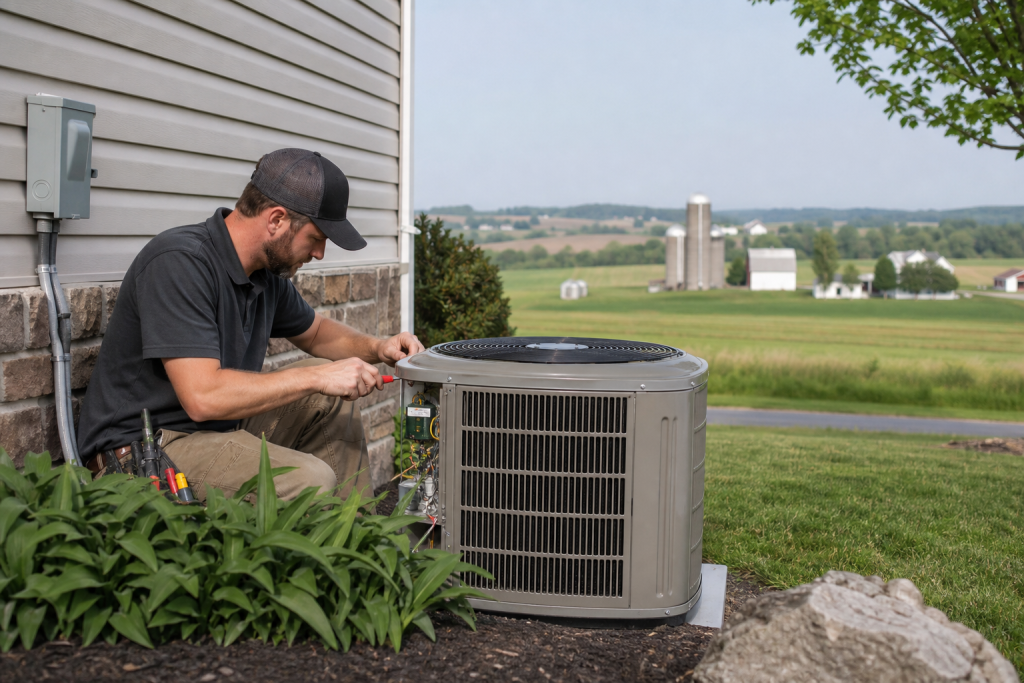
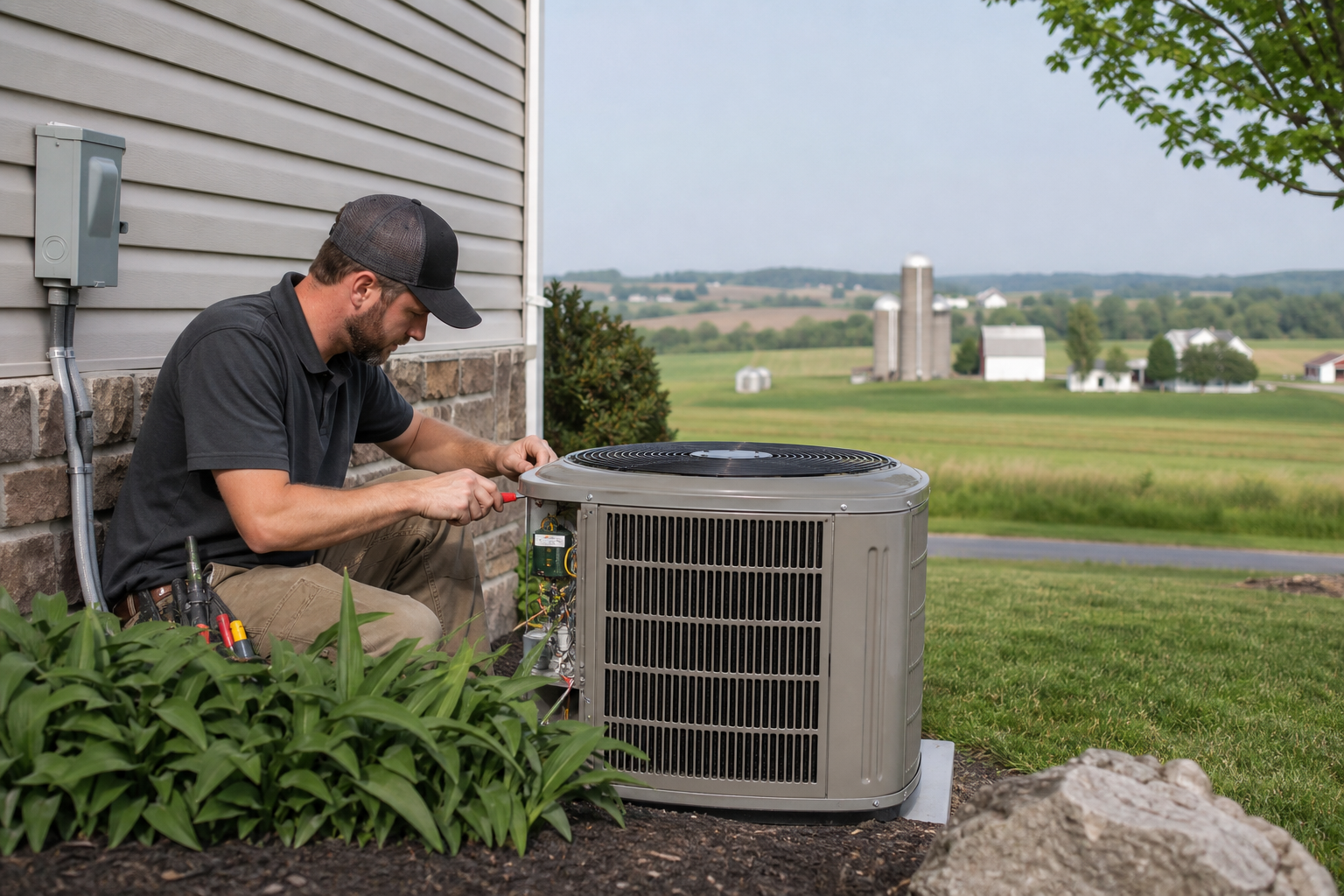
5. Check the outdoor disconnect. There’s a gray box mounted on the wall near your condenser. Open it and verify the pull-out switch is fully seated. We’ve found them partially dislodged by lawn crews, kids, or curious squirrels. Also check that the condenser’s fan spins freely when nudged - if it’s seized, that’s a motor or capacitor issue.
Run these checks, and about one in three times, you’ll solve it yourself. The other two times, you’ll at least know what to tell the technician, which saves diagnostic time and money.
How to Tell What’s Actually Broken: Outdoor Unit vs. Air Handler
This distinction matters. When Lancaster homeowners call us saying “the AC is out,” we need to know which part isn’t working - it changes everything about what we bring and what it costs.
If the outdoor unit runs but you get no cold air: The compressor and fan are humming, but your vents blow warm or room-temperature air. Common causes: low refrigerant from a leak, a failed compressor, or a reversing valve issue on heat pumps. This is pro territory - refrigerant handling requires EPA certification, and leak detection takes specialized equipment.
If the outdoor unit is silent but the indoor blower runs: You’re hearing the air handler push air, but there’s no cooling happening. Check that disconnect and breaker first. If those are fine, you likely have a failed capacitor, contactor, or compressor. Capacitors are cheap fixes. Compressors are not. A good tech will test before quoting replacement.
If nothing runs at all: No indoor blower, no outdoor hum. This points to power, control board, or thermostat issues. Start with that breaker. If resetting doesn’t help, call us - but now you can say “nothing runs, breaker is reset,” which tells us to bring a multimeter and control board tester.
Last August, we pulled into a driveway over in Lititz where the homeowner had already been told she needed a new American Standard system. Outdoor unit was silent. We checked the disconnect - the pull-out had been bumped by her landscaper. Seated it properly, unit fired right up. She’d been quoted $6,200 for a replacement she didn’t need. That’s the heat-pressure effect, and it’s why we always verify before we quote.
What to Say (and Not Say) When You Call an HVAC Company
How you phrase your call shapes what you’re sold. Desperate language gets desperate pricing. Here’s how to stay in control.
Say this: “My AC isn’t cooling. I’ve checked the breaker and filter. The outdoor unit [is/isn’t] running. I’d like a diagnostic and a written estimate before any work begins.” This signals you’re informed, you’re shopping, and you expect paperwork.
Don’t say this: “I need someone out here today, my house is unbearable, I’ll pay whatever.” That telegraphs desperation. Some operators track “urgency language” and price accordingly. We’ve heard the stories from Lancaster homeowners who called around in 95-degree heat and got quotes 40% higher than their neighbor’s identical repair.
Ask these questions:
- What is your diagnostic fee, and does it apply to the repair?
- Do you provide upfront pricing in writing before work starts?
- Are your technicians employees or subcontractors?
- What is your guarantee if the repair doesn’t solve the problem?
At Fireside, our answer to that last one is the 90-Day Done Right Promise: if it’s not done right, we make it right, in writing, no paperwork, no arguing. We’ve stood behind that since 1984. But whatever company you call, get their guarantee in specific terms - not “we stand behind our work,” but exactly how long and exactly what happens if it fails.
What “Same-Day” Actually Means During a Lancaster Heat Wave
When the heat index hits 105 in Lancaster, every HVAC company in the county is buried. Here’s how dispatch actually works, and what you should realistically expect.
Most reputable shops run 4-8 service calls per technician on a normal summer day. During a heat wave, that doubles. “Same-day” often means “before midnight,” not “before dinner.” Some companies overbook, then call at 8 p.m. to reschedule. Others send their least experienced techs to the overflow calls.
At Fireside Heating & Air Co., we answer with a live person 24 hours a day, 7 days a week - including the 2 a.m. no-cool emergency. No voicemail tree. When you call, we tell you honestly where you sit in the queue and what window we’re targeting. If we can’t make same-day happen, we’ll tell you that upfront, not at 9 p.m. after you’ve waited around all day.
Our AC repair and installation team in Lancaster carries parts for nine major brands: Carrier, Trane, Lennox, Goodman, Rheem, York, Daikin, Bryant, and American Standard. Most repairs we complete in a single visit because our trucks are stocked for Lancaster’s common failures - capacitors, contactors, motors, and refrigerant leaks on the units we see most.
If your system is truly dead and replacement is the honest recommendation, we provide a free second opinion on any written estimate you’ve already received. Bring us their paperwork. We’ll tell you straight if they’re right or if you’re being sold something you don’t need.
Keeping Your Home Livable While You Wait
Sometimes even the best company can’t get there for hours. Here’s how Lancaster homeowners manage the interim without risking heat illness, especially for older residents or anyone with respiratory conditions.
Window unit strategy: If you have a portable or window AC, deploy it to one closed room - usually a bedroom. Seal that room with towels under the door. One cool room beats a whole house of lukewarm air. Run it on high until the room drops, then switch to “energy saver” to maintain.
Attic fan and whole-house fan use: Lancaster’s older homes, especially in neighborhoods like Chestnut Hill and near Franklin & Marshall, often have original attic fans. If yours works, run it from 6 p.m. to 8 a.m. to pull cool night air through the house. Close it up by 9 a.m. to trap that coolness.
Close registers in unused rooms: If your air handler still runs but weakly, force what cool air exists to where you actually are. Don’t close more than 30% of registers or you risk pressure damage to the ductwork.
Hydration and cooling tactics: Cold showers, damp cloths on the neck and wrists, and avoiding cooking or running the dryer. If indoor temperatures exceed 85 degrees for vulnerable residents, consider a cooling center - the Lancaster Public Library and Park City Center both served this role during the 2024 heat emergency.
For heat pump and mini-split systems in Lancaster, the same principles apply, but check your outdoor unit’s defrost board too - a confused board in extreme heat can shut the system down protectively. Resetting power at the breaker for a full 30 seconds sometimes clears this.
When to Call a Pro (and When You’re Just Delaying the Inevitable)
There’s a difference between a quick fix and throwing good money after bad. Here’s how we think about it after 42 years in Lancaster homes.
Call immediately if: You smell burning, see refrigerant oil pooling under the condenser, hear grinding or screeching from either unit, or the breaker trips repeatedly. These are safety issues. Refrigerant leaks damage the environment and your compressor. Electrical burning is a fire risk. Don’t wait.
Repair is the right call when: Your system is under 12 years old, the repair is under $1,000, and you’ve maintained it reasonably. A new capacitor, contactor, or motor on a Carrier or Trane system with good bones buys you years.
Replacement is the honest recommendation when: Your system uses R-22 refrigerant (phased out, expensive), you’re facing a compressor failure on a unit over 10 years old, or repair costs exceed 40% of replacement. At that point, you’re paying new-system money for old-system efficiency. Heating and furnace considerations in Lancaster follow similar math - we run the numbers with you, no pressure.
We don’t sell equipment we wouldn’t put in our own mother’s house. That’s not a slogan - it’s how our technicians are trained. Shoe covers on without being asked, floors protected, and straight talk about whether repair or replace makes sense for your situation.
The Bottom Line
Your first 45 minutes after the AC quits should be methodical, not panicked. Check the thermostat, breaker, filter, drain, and disconnect. Know whether your outdoor unit or air handler is the problem. Call with specific language that shows you’re informed. Ask about guarantees, upfront pricing, and technician qualifications. And while you wait, focus cooling on one room and stay hydrated.
If you’re in Lancaster and you’ve run through the checklist without success, or if you’d rather not troubleshoot yourself, Fireside Heating & Air Co. offers free estimates - call (866) 561-3358. A live person will answer, day or night, and we’ll give you an honest window for when we can be there. Most repairs are completed in a single visit, backed by our 90-Day Done Right Promise: done right, or we make it right, in writing, no arguing.
Frequently Asked Questions
Most AC repairs in Lancaster run between $180 and $650, depending on the part and the time of day. Capacitors and contactors are on the lower end; compressor or refrigerant leak repairs trend higher. We charge upfront pricing - the quote you approve is the price you pay, full stop. Call (866) 561-3358 for an exact diagnostic quote; estimates are free.
Same-day service is possible but not guaranteed during peak demand. Reputable companies are honest about their queue rather than overpromising. At Fireside, a live person answers 24/7 and tells you exactly where you stand. We prioritize elderly residents, homes with infants, and anyone with medical needs. Call early in the morning for your best shot at same-day scheduling.
Repair is cheaper today. Replacement is cheaper over the next decade if your system is old, inefficient, or prone to breakdowns. Our rule: if the repair exceeds 40% of replacement cost and your unit is over 10 years old, we show you both options with honest math. We also offer a free second opinion on any written estimate you’ve already received.
We carry parts and train our journeyman technicians on nine major brands: Carrier, Trane, Lennox, Goodman, Rheem, York, Daikin, Bryant, and American Standard. Most Lancaster homes run one of these, which is why we stock our trucks for same-visit completion on common failures. If you have a less common brand, call ahead and we’ll verify parts availability.
Written by the team at Fireside Heating & Air Co., serving Lancaster since 2018.
Need HVAC Help?
Call Fireside Heating & Air Co. - licensed & insured, here with fast after-hours help in Lancaster.
(866) 561-3358