
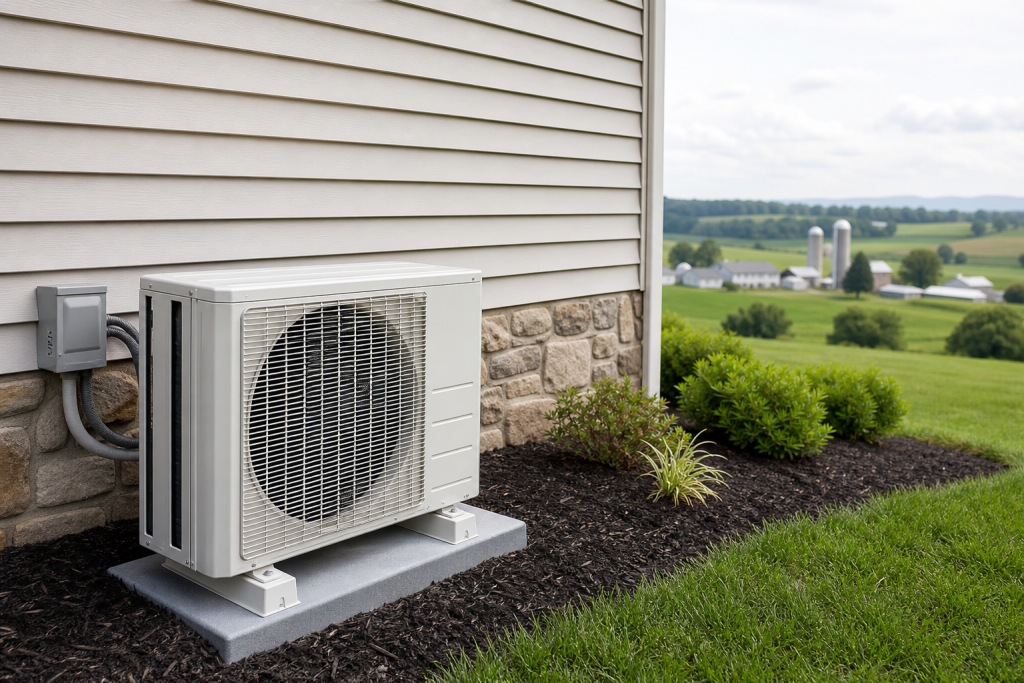
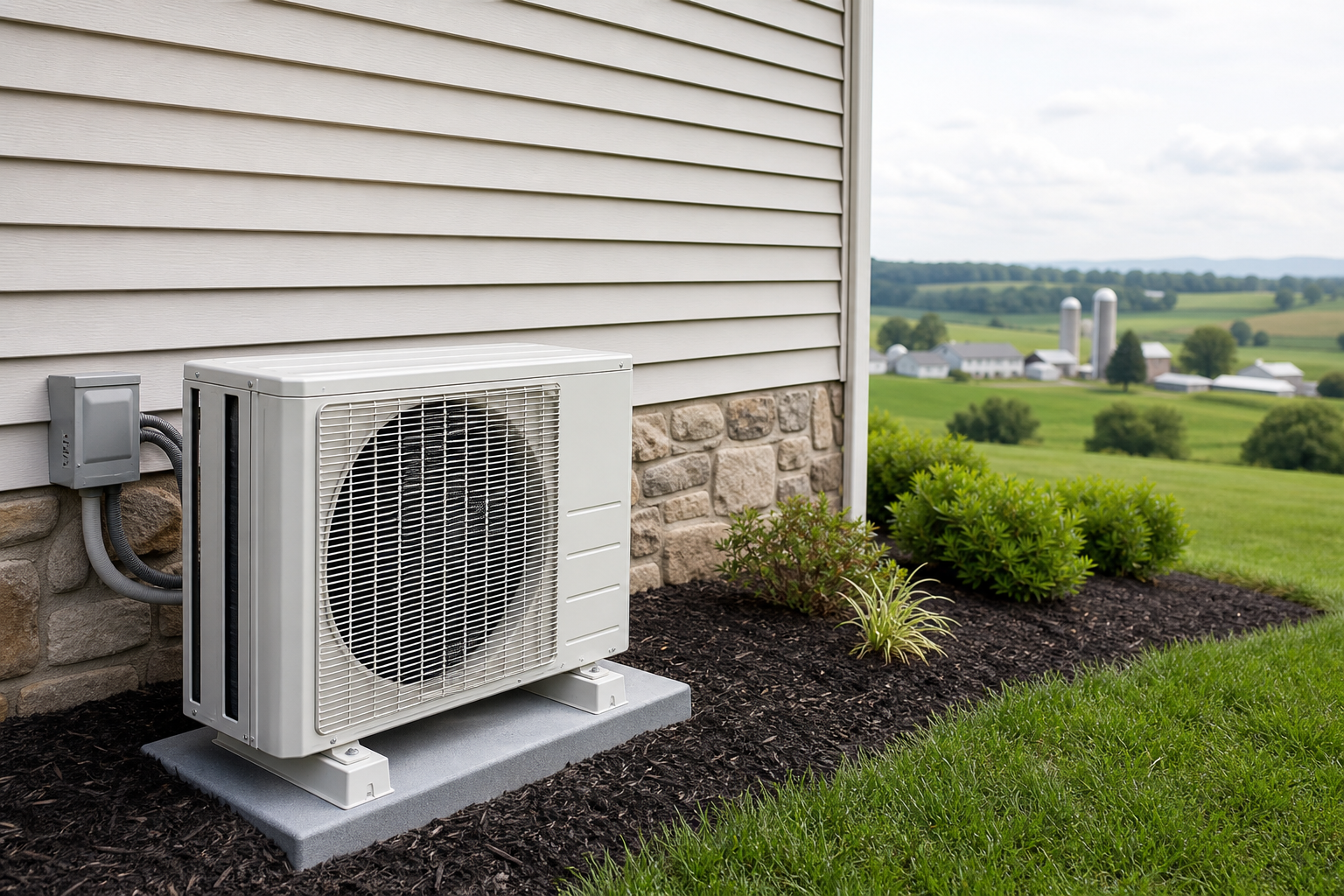
5 Mistakes to Avoid With Heat Pump & Mini Split
Heat pumps and mini-splits are not furnaces with a different name. They move heat instead of making it, and that difference changes everything about how you set them, clean them, and judge their behavior. The five costliest mistakes we see in Lancaster homes all come from treating this equipment like the gas-fired systems most homeowners grew up with. If you’d rather not sort through the details yourself, call Fireside at (866) 561-3358 - we answer live, day or night, and we’ll give you straight talk about what your system actually needs.
1. Running ‘Emergency Heat’ Like a Regular Setting
Here’s the one that stings when the electric bill arrives. A heat pump thermostat’s “Emergency Heat” or “EM Heat” position does not make your house warm up faster. It shuts the heat pump off entirely and switches to electric resistance strips - basically a giant toaster element inside your air handler. Those strips draw two to three times the power of the compressor, and in a Lancaster January, running them for weeks instead of hours can add $150 to $250 to a single month’s bill.
We get the call every February: “Our bill doubled and we don’t know why.” Nine times out of ten, someone flipped to EM Heat during a cold snap and never flipped back.
Emergency heat has exactly two legitimate jobs. First, when your outdoor unit fails completely and you need heat while waiting for repair. Second, when outdoor temperatures drop below the balance point where your specific heat pump can no longer pull sufficient heat from the air - typically somewhere between 25 and 35 degrees for most residential units in Lancaster County, depending on sizing and insulation. Even then, a properly configured system with auxiliary heat should handle that transition automatically. You should almost never need to select EM Heat manually.
If your heat pump seems to struggle in normal Lancaster winter conditions, the problem is usually sizing, charge level, or a failing component - not the thermostat setting. Forcing the strips on masks the real issue while it empties your wallet.
2. Cranking the Temperature to ‘Make It Work Faster’
This mistake is so understandable that we don’t blame anyone for trying it. You come home to a cold house, set the mini-split to 85 degrees thinking it’ll heat up quicker, then forget about it. With a gas furnace, that logic is mostly harmless - the burner runs at full fire until the thermostat satisfies, then shuts off. With an inverter-driven mini-split or heat pump, you’ve just sabotaged the very feature that makes the equipment efficient.
Inverter systems modulate their compressor speed to match the load. Set at a reasonable temperature - say, 70 degrees - the unit runs at partial speed, maintains steady output, and cycles efficiently through Lancaster’s unpredictable shoulder seasons where mornings hit 40 and afternoons touch 65. Crank it to 85, and the compressor runs at maximum RPM continuously, never reaching the setpoint, never modulating down, and burning through electricity at the worst possible efficiency curve.
The same damage happens in reverse during summer: setting a mini-split to 62 degrees in July doesn’t cool the room faster. It just makes the unit work at full bore indefinitely, often freezing the indoor coil and triggering a protective shutdown that leaves you hotter than when you started.
Set it where you want it. These systems are designed to reach temperature gradually and hold it efficiently. Patience pays back in lower bills and longer equipment life.
3. Ignoring the Refrigerant Lines Running Through Unconditioned Space
Mini-splits have an Achilles heel that conventional split systems share but mini-splits expose more brutally: the line set. That pair of copper tubes carrying refrigerant between the outdoor condenser and the indoor head must stay insulated, dry, and properly supported for the system’s entire life. In Lancaster’s older housing stock - the stone farmhouses, the post-war brick ranches, the converted carriage houses - we see line sets routed through uninsulated attics, damp crawl spaces, and exterior walls that were never designed for them.
Insulation degrades. Critters get into crawl spaces. Condensation forms where it shouldn’t, and where condensation forms on a refrigerant line, two things happen. First, energy efficiency drops because the refrigerant absorbs or sheds heat in the wrong places. Second, water invites corrosion, and a pinhole leak in a mini-split line set is not a field repairable item in most cases - it’s often a full line set replacement, sometimes requiring interior finish work to access.
We pulled one out of a garage over in Manheim Township last month where the lines ran through an unvented attic space. The insulation had slipped, condensation had pooled for two winters, and the suction line was pitted so badly we could flake the copper with a fingernail. The homeowner had no warning until the system lost enough charge to ice up the indoor head.
Annual inspection of the line set path, insulation condition, and support hangers belongs on the same schedule as filter changes. It’s not glamorous work, but it’s the difference between a $89 tune-up and a $2,400 line set replacement with drywall repair.
4. Cleaning Mini-Split Indoor Heads With Household Spray Cleaners
The indoor head of a ductless mini-split is not a window air conditioner, and it’s definitely not a surface you can hit with whatever cleaner is under the kitchen sink. The evaporator coil behind that front panel carries a hydrophilic coating - a factory-applied treatment that helps condensed moisture spread evenly and drain properly rather than beading up and blowing into your room as mist. That coating is fragile, and it’s doing a job you never notice until it fails.
Household cleaners, even “gentle” ones, strip this coating. So do paper towels, abrasive pads, and aggressive brushing. We’ve opened units in Lancaster homes where the coil looked clean as a whistle and performed like a clogged drain - the coating was gone, water was pooling in random spots, and the fan was throwing humidity back into the room instead of down the condensate line.
Proper cleaning uses low-pressure foaming cleaner formulated specifically for HVAC evaporators, applied with the unit powered off, allowed to dwell, then rinsed gently and drained completely. The blower wheel needs attention too - it collects the same dust and biofilm, and it’s even more sensitive to imbalance if cleaned improperly.
If you’re comfortable removing the front panel and following manufacturer guidance for your specific brand - whether that’s a Daikin, a Lennox, or another model - you can handle basic filter washing and light surface cleaning. Anything involving the coil itself, the blower wheel, or the drain pan is worth a professional touch. The Heat Pump & Mini Split in Lancaster team at Fireside carries the right chemistry and the right technique for each brand we service.
5. Mistaking Normal Defrost for a Broken System
This one costs homeowners in unnecessary service calls, or worse, in ignored real failures because they stopped trusting their own observations. A heat pump in heating mode will periodically reverse itself to defrost the outdoor coil. In a Lancaster winter morning, with temperatures in the low 20s and humidity hanging in the air, you might see this several times an hour during the coldest periods. It looks wrong. It sounds wrong. It is exactly right.
Here’s what normal defrost looks like: the outdoor fan stops while the compressor keeps running, the unit may emit a brief whoosh or gurgle as the reversing valve shifts, and for a few minutes the system is not heating your home. Some units trigger auxiliary heat indoors during this interval to maintain temperature; others let the house drift slightly. The outdoor coil will steam visibly as frost melts - that white cloud is not smoke, and it’s not a sign of overheating. After two to ten minutes, the fan restarts, the valve shifts back, and heating resumes.
Here’s what a failed defrost board looks like: ice builds continuously, never clearing, until the outdoor unit resembles a white block. The system loses capacity, runs constantly, and eventually trips on high pressure or low refrigerant. Or, conversely, the unit defrosts constantly, never completing a full heating cycle, often because a defrost sensor has failed or the board has lost its timing logic.
The dangerous middle ground is the homeowner who sees normal defrost, assumes malfunction, and either disables the system or calls for emergency service unnecessarily. Then, six months later, they see actual ice buildup, remember “that was normal,” and wait too long. By the time we get the call, the compressor has been slugging liquid refrigerant and the repair has tripled.
When in doubt, photograph the unit during the event and call us. We’ve seen every defrost pattern on nine major brands across forty-two Lancaster winters. We can tell you in thirty seconds whether what you’re seeing belongs on the schedule or needs same-day attention.
When to Call a Pro
Some of these mistakes are fixable with a settings change and a calendar reminder. Others involve components - refrigerant charge, defrost boards, line set integrity - that require licensed handling and proper tooling. If your heat pump or mini-split in Lancaster is underperforming, spiking your electric bill, or behaving in ways you can’t explain, a quick diagnostic visit usually answers the question in under an hour. Our Fireside Heating & Air Co. home page has more on how we work, or you can reach us directly at (866) 561-3358 - live person, any hour.
The Bottom Line
Heat pumps and mini-splits reward a different kind of attention than the gas furnaces most Lancaster homeowners grew up with. The five mistakes above - treating emergency heat as a booster, overriding inverter logic with extreme setpoints, neglecting line sets in unconditioned spaces, cleaning coils with the wrong chemistry, and misreading defrost cycles - all share one root cause: applying furnace logic to equipment that follows heat-pump rules.
The good news is that once you understand the difference, these systems are straightforward to live with and genuinely economical to operate through Lancaster’s full range of weather. The better news is that you don’t have to become the expert yourself.
Fireside Heating & Air Co. has served Lancaster County homeowners for over 42 years. Our 90-Day Done Right Promise means if it’s not done right, we make it right - in writing, no paperwork, no arguing. Calls are answered by a live person 24 hours a day, including the 2 a.m. no-heat emergency. We offer a $89 Seasonal Tune-Up, $50 off any repair over $250, free second opinions on any written estimate, and a permanent 5% discount for seniors and veterans.
If your heat pump or mini-split has you second-guessing, call (866) 561-3358 for a free estimate. We’ll give you straight talk about whether it’s a settings fix, a maintenance need, or time to discuss replacement - and the price we quote is the price you pay.
Frequently Asked Questions
Most heat pump repairs in Lancaster fall between $175 and $650, depending on whether it’s a capacitor replacement, a reversing valve issue, or a compressor problem. We diagnose first, quote upfront, and apply $50 off any repair over $250. Call (866) 561-3358 for an exact figure on your system - estimates are free.
If your heat pump is over twelve years old and the repair exceeds a third of replacement cost, replacement usually wins on reliability and efficiency. For newer systems, repair almost always makes sense. We give straight talk on repair versus replace - no pressure, just the numbers. Call (866) 561-3358 and we’ll walk through it with you.
It may be in a normal defrost cycle, which temporarily reverses the system to clear outdoor coil ice. If cold air persists beyond ten minutes, or if the outdoor unit is iced over, you likely have a defrost sensor, board, or refrigerant issue. Either way, a quick call to (866) 561-3358 gets you a definitive answer - we answer live, day or night.
Once yearly, ideally before the heating or cooling season that stresses it most. Lancaster’s mix of humid summers and freeze-thaw winters puts particular load on mini-split line sets and outdoor coils. Our $89 Seasonal Tune-Up covers filter cleaning, coil inspection, refrigerant check, and line set condition - schedule at (866) 561-3358.
Written by the team at Fireside Heating & Air Co., serving Lancaster since 1984.
Need HVAC Help?
Call Fireside Heating & Air Co. - licensed & insured, here with fast after-hours help in Lancaster.
(866) 561-3358