
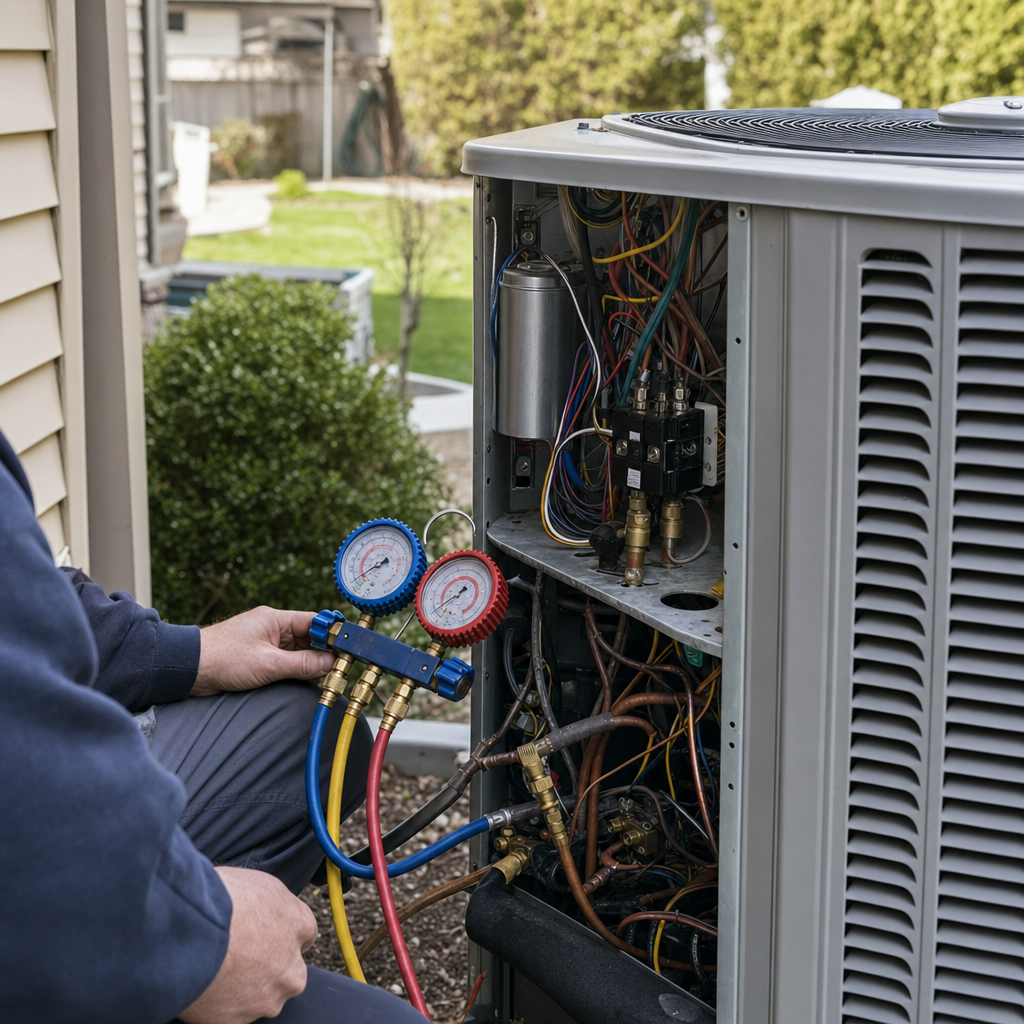
The Best HVAC System for Cold Climates in Lancaster, PA Depends on What’s in Your Basement
For most Lancaster County homeowners, a cold-climate heat pump paired with a propane backup furnace delivers the lowest annual heating cost - but only if your home has ductwork and you’re on propane. If you live in one of Lancaster City’s pre-1940 row homes with original steam radiators, keeping that boiler alive with proper water treatment is often the smarter long-term play. Call Fireside at (866) 561-3358 and we’ll walk through which constraint actually matters for your house.
Glen Hartman grew up in the Cabbage Hill neighborhood of Lancaster and spent enough winters in drafty row houses to know early on that heating wasn’t a luxury. He trained in HVAC systems at Thaddeus Stevens College of Technology right here in Lancaster, then spent the next four decades turning that foundation into the kind of hands-on knowledge you only get from crawling through a few thousand attics and basements. We’ve learned that Furnace Blowing Cold Air in Lancaster, PA isn’t the only cold-climate challenge - it’s not just temperature. It’s the combination of reliable hard freezes, a propane-dependent rural housing stock beyond the gas grid, and karst hard water that attacks boilers and hydronic systems faster than nearly anywhere else in the mid-Atlantic. No single system type wins across all three scenarios.
Why Lancaster’s Hard Water Changes the Math on “Best”
Lancaster sits on limestone karst geology. That means your tap water carries more dissolved calcium and magnesium than nearly anywhere else in Pennsylvania. We’ve pulled boiler heat exchangers in Manheim Township that looked like they were filled with concrete. Scale deposits an eighth-inch thick aren’t unusual after five or six years without treatment.
This matters because the internet’s favorite cold-climate recommendation - high-efficiency condensing boilers with aluminum or stainless-steel heat exchangers - will fail prematurely here without a water treatment plan built into your maintenance schedule. We’ve replaced heating and furnace systems in Lancaster homes where the previous contractor never mentioned water hardness at all. The homeowner got eight years instead of twenty.
If you’re comparing boiler options for a Lancaster property, factor in annual water treatment service. Our $89 seasonal tune-up includes hardness testing and inhibitor levels. Skip it, and that “best” efficiency rating becomes expensive scrap metal.
Dual-Fuel Hybrid Systems: The Rural Lancaster County Sweet Spot
Beyond Lancaster City limits, natural gas infrastructure thins out fast. Most farmhouses and post-war ranches run on propane. Propane prices swing hard in Pennsylvania winters, and a propane furnace alone can cost $2,500-$4,000 per heating season for a 2,000-square-foot home.
A cold-climate heat pump, properly sized, can handle the bulk of your heating load down to about 5°F. Lancaster winter nights routinely hit that mark. Below it, a propane furnace takes over automatically. The key is the heat pump’s capacity rating at low temperatures - not its headline efficiency number. We install Lennox and Carrier units rated to maintain 80% of capacity at 5°F, which is the threshold that actually matters here.
Annual operating cost for a dual-fuel hybrid in Lancaster County typically runs 30-40% below propane-only, assuming the heat pump carries the load above the switchover point. But the savings disappear fast if your installer sizes for cooling load alone and the heat pump switches to propane at 25°F instead of 5°F. We’ve fixed that mistake more than once.
System Comparison for Lancaster Propane Homes
| System Type | Typical Install Range | Annual Operating Cost (2,000 sq ft) | Best For |
|---|---|---|---|
| Propane furnace only | $3,500-$6,500 | $2,500-$4,000 | Low upfront budget, short-term ownership |
| Cold-climate heat pump + propane backup | $6,500-$10,500 | $1,400-$2,200 | Long-term homeowners, stable electric rates |
| Geothermal | $18,000-$35,000 | $800-$1,400 | Rural properties with land, 15+ year horizon |
Our 90-Day Done Right Promise applies to every installation. If we size the switchover wrong for your actual Lancaster winter, we make it right - in writing, no paperwork, no arguing.
When Keeping the Old Steam System Is Actually the Right Call
In Lancaster City’s densest neighborhoods - Cabbage Hill, the Southeast quadrant, blocks around Reservoir Park - we still find original early-1900s one-pipe steam boilers in daily use. Cast-iron sectional boilers, fed by coal originally, converted to gas or oil decades ago. These systems are crude by modern standards. They’re also nearly indestructible and deliver a quality of heat that forced-air systems cannot replicate.
Steam radiators are high-mass radiant heat. A forced-air furnace blasting 120°F air cycles on and off, creating temperature swings. A steam radiator at 70°F outside or 5°F outside holds steady within a degree or two. In a narrow brick row home with plaster walls and no insulation, that stability matters more than an AFUE percentage.
The catch is water. Those original boilers were built for softer water, and Lancaster’s hardness attacks them too. We’ve replaced sections on boilers that should have lasted another generation because scale caused localized overheating. The fix isn’t replacement - it’s a water treatment plan and annual cleaning that most homeowners never knew they needed.
For these homes, adding cooling means ductless mini-split expertise or creative hydronic upgrades. Standard ductwork is impractical in 16-foot-wide row houses with plaster walls. We’ve installed Daikin and Mitsubishi ductless systems in Lancaster City homes where the historic preservation guidelines prohibited exterior penetrations on front facades, running line sets through interior chase ways that took real planning to execute cleanly.
How to Choose: A Three-Question Framework
- What’s your water situation? If you’re on well water or city water in Lancaster, get it tested. Hardness above 15 grains per gallon means any boiler or hydronic system needs treatment built into maintenance.
- What’s your fuel source? Natural gas in the city opens different options than propane in the county. Electric-only rural properties face a different calculation entirely.
- What’s your home’s construction era? Pre-1940 row homes with steam radiators demand a contractor fluent in hydronic systems, not just forced-air replacement. Post-war ranch homes with existing ductwork are straightforward hybrid candidates.
Tell me what your system is doing, and I’ll tell you what it needs. That’s the whole conversation.
Key Takeaways
- Lancaster’s karst hard water destroys boilers faster than soft-water markets - water treatment isn’t optional here.
- Propane-dependent rural homes typically save 30-40% on heating costs with a properly sized cold-climate heat pump hybrid.
- Original steam systems in Lancaster City row homes often outperform replacements for comfort and longevity, if maintained correctly.
- Any “best” system recommendation without knowing your water, fuel, and construction type is just guessing.
FAQs
A cold-climate heat pump with propane backup furnace typically runs $6,500-$10,500 installed in Lancaster County, while a standard propane furnace replacement runs $3,500-$6,500. The hybrid costs more upfront but usually pays back in 4-7 years through lower propane consumption. Call (866) 561-3358 for a free estimate based on your home’s actual layout and fuel source.
If your Lancaster home has a cast-iron steam boiler under 40 years old, repair is usually the better value - replacement boilers with comparable durability start around $8,000 and won’t deliver better heat. The exception is when scale damage from hard water has cracked sections or clogged returns beyond practical repair. Our $89 seasonal tune-up includes an honest assessment of Furnace Repair versus replace; we don’t sell equipment you don’t need.
Yes, if it’s a cold-climate model rated to maintain capacity at 5°F - which Lancaster nights routinely hit. Standard heat pumps switch to backup heat around 25-35°F and become expensive to run. We install Lennox and Carrier cold-climate units specifically selected for this region’s temperature profile, not just its cooling load.
Install a water softener or boiler-specific treatment system, and include annual water testing in your maintenance schedule. Our tune-ups check inhibitor levels and scale buildup; without treatment, we’ve seen boiler heat exchangers fail in 6-8 years that should have lasted 20. The protection costs far less than early replacement.
Ready to Sort Out What Your Lancaster Home Actually Needs?
We’ve served Lancaster County for over 8 years. Our phones are answered by a live person, 24 hours a day, every day of the year - including the 2 a.m. Emergency Heating & Furnace in Lancaster, PA call. Every technician is background-checked, uniformed, and trained to work in your home the way they would in their own mother’s. And every job is backed by our 90-Day Done Right Promise: the price quoted is the price paid, and if it’s not done right, we make it right without paperwork or argument.
Current offers: $50 off any repair over $250, free second opinion on any written estimate, $89 seasonal tune-up, and a permanent 5% Senior and Veteran discount.
If you’d rather have it looked at, Fireside Heating & Air Co. offers a no-pressure assessment in Lancaster - call (866) 561-3358.
Written by Glen Hartman, Owner at Fireside Heating & Air Co., serving Lancaster, PA.