
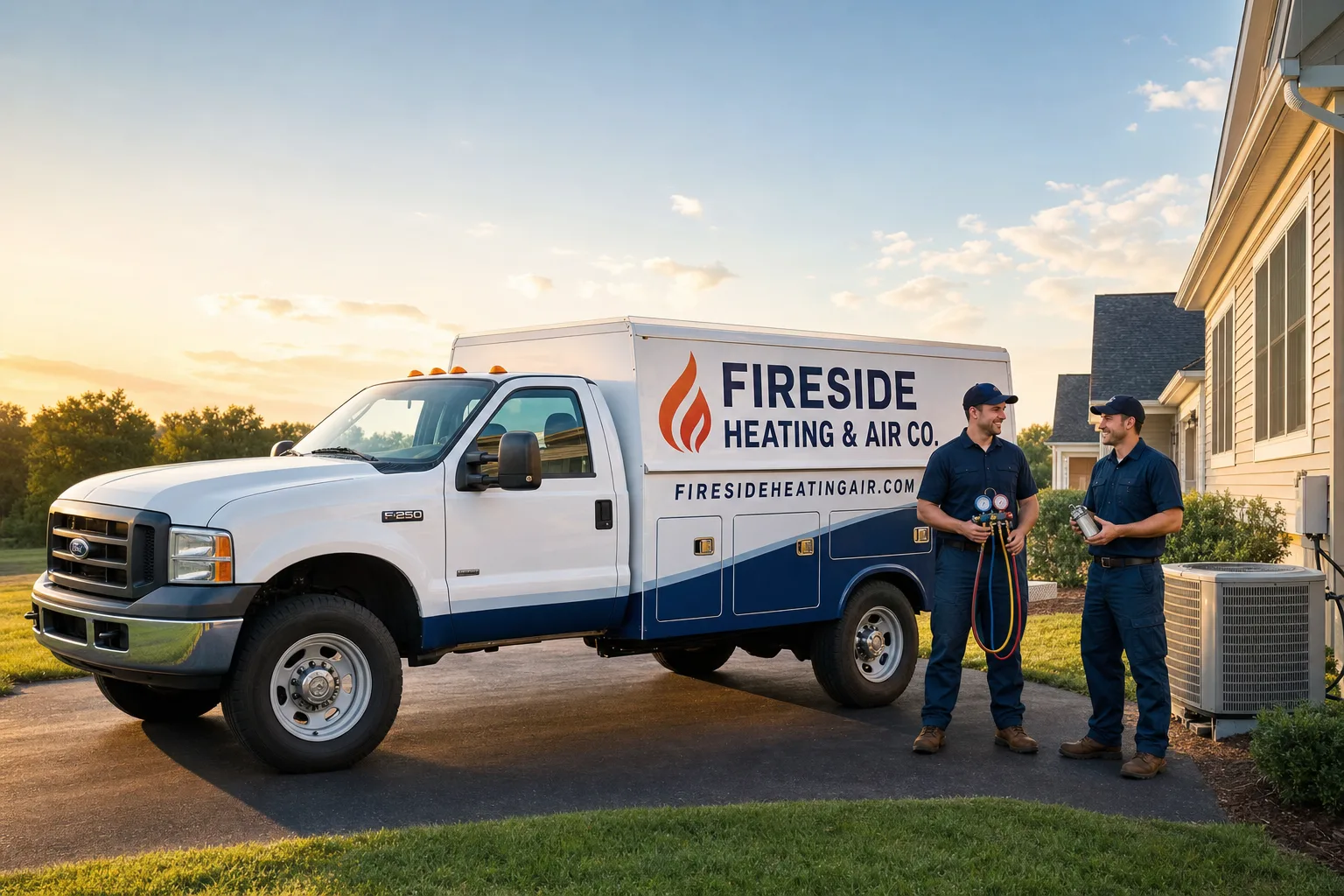
A/C Won’t Turn On at All
What’s Happening
When your air conditioner won’t turn on at all, the most common causes are a tripped circuit breaker, a blown fuse at the disconnect box near the outdoor unit, or a failed capacitor that leaves the system completely dead at the thermostat. In most cases, one of those three things is the reason – and a trained technician can pinpoint which one within the first few minutes on site.
It feels urgent because it is. A system that won’t respond to the thermostat at all – no fan, no compressor hum, no clicking relay – is not a “wait and see” situation, especially on a hot day. The good news is that a no-start condition is one of the more straightforward HVAC diagnoses. There’s a logical sequence of components that carry power to your system, and a dead unit almost always points to one of them. The hard part isn’t the diagnosis; it’s knowing where in that sequence to look – and what’s safe to check yourself versus what you should leave alone.
Why It Happens
Tripped Circuit Breaker or Blown Disconnect Fuse
Your air conditioner runs on a dedicated circuit, and that circuit has a breaker in your main electrical panel. If the breaker trips – or if the fuses in the disconnect box mounted near the outdoor unit blow – the system loses power entirely and won’t respond to anything. You’ll know this is the likely cause if the breaker handle sits in the middle position rather than fully toward “on,” or if you flip it to off and back to on and the unit still doesn’t start. A disconnect fuse failure looks identical from the thermostat but requires a multimeter to confirm. Do not keep resetting a breaker that trips again immediately – that’s a sign of a deeper electrical fault, and repeated resets can cause a fire.
Failed Run Capacitor
The run capacitor is a small cylindrical component inside the outdoor unit that gives the compressor and fan motor the electrical jolt they need to start. When it fails, those motors simply won’t spin – the system is powered but the fan and compressor can’t engage, so nothing happens. A telltale sign is a humming sound from the outdoor unit right before it goes completely silent. Capacitors are under significant electrical charge even after the unit is switched off. Do not open the outdoor cabinet or touch any internal components yourself – this is a job for a technician with the right tools to safely discharge the capacitor before handling it.
Thermostat Power or Settings Failure
A thermostat that’s lost power – dead batteries, a tripped internal fuse, or a wiring fault – sends no signal to the system at all, which looks exactly like a dead AC from the outside. Check whether the thermostat display is on and showing a temperature reading. If the screen is blank, start with the batteries. If replacing them doesn’t help, or if the display is on but the system still won’t respond after you confirm it’s set to “cool” and the set temperature is below the room temperature, the problem may be in the low-voltage wiring that runs between the thermostat and the air handler.
Contactor Failure in the Outdoor Unit
The contactor is an electrical switch inside the outdoor unit that sends high-voltage power to the compressor when the thermostat calls for cooling. Contactors wear out over time – pitting on the contact points, a stuck relay, or burned wiring can leave the outdoor unit completely unresponsive even when everything else in the system has power. You might hear a faint clicking from the outdoor unit when the thermostat calls for cooling but nothing actually starts. Like the capacitor, the contactor carries lethal voltage. Visual inspection of wiring condition is fine from a distance, but any hands-on work requires a trained technician.
What to Do Right Now
- Check the thermostat first. Confirm the display is on, the mode is set to “cool,” the fan is set to “auto,” and the target temperature is at least three degrees below the current room temperature. This takes thirty seconds and rules out a settings issue.
- Check your main electrical panel. Find the breaker labeled for the AC or air handler and look at its position. If it’s tripped (sitting in the middle), switch it fully to off and then back to on – one time only. If it trips again, stop and call. Do not reset a repeatedly tripping breaker.
- Look at the outdoor disconnect box. There’s a gray or beige box mounted on the wall near the outdoor unit. It should have a pull-out block or breaker inside. If it’s visibly burned, smells of melted plastic, or the pull-out block is missing, leave it alone and call immediately.
- Turn the system off at the thermostat and leave it off. If you’ve done the checks above and nothing has worked, the best thing you can do for the equipment is switch the thermostat to “off” rather than letting it cycle and call repeatedly against a component that isn’t responding.
- Take a photo of anything that looks unusual. A tripped breaker, a burned disconnect, a bulging or leaking capacitor visible through the cabinet vents – photograph it before you touch anything. That information helps a technician prepare before they arrive.
How We Fix It
When your local Fireside Heating & Air Co. technician arrives, the first thing they do is a full power and controls check – thermostat signal, low-voltage wiring, disconnect fuse condition, and panel breaker – to locate exactly where in the circuit the problem sits. From there, they test the capacitor, contactor, and any control boards with calibrated equipment, not guesswork. For most no-start calls, that diagnostic sequence is complete within the first half hour, and the repair follows directly.
The services that resolve a no-start condition are AC Repair and, when the equipment has failed beyond practical repair, AC Installation. Before any work begins, you’ll have a written estimate with the price clearly stated – that’s the price you’ll pay, no revisions, no surprises on the bill. That’s not a slogan; it’s how we’ve operated since 1984. Most no-start repairs are completed in a single visit. The job is backed by our 90-Day Done Right Promise: if it’s not right, we come back – no paperwork, no arguing. That’s the Keystone Standard, in writing, every time.
Frequently Asked Questions
A system that won’t turn on isn’t actively dangerous the way a gas leak is, but it can become a problem quickly in extreme heat, particularly for older adults, young children, or anyone with a medical condition. Beyond the health concern, a tripped breaker that’s masking a wiring fault or a failing contactor that’s drawing excessive current is worth addressing promptly – not because we want to alarm you, but because catching an electrical issue early is always cheaper and safer than waiting. Call us at (866) 561-3358 and we’ll help you decide how urgent your specific situation is.
If temperatures in your home are still manageable and you’ve confirmed the breaker is fine and the thermostat has power, it can sometimes wait until the next morning – but we wouldn’t let it go longer than that. If it’s mid-summer, if anyone in the household is elderly or has a health condition, or if you saw anything burned or smelled anything unusual, call today. We answer around the clock – a live person picks up every call at (866) 561-3358, including nights, weekends, and holidays.
No. A system that sat unused over winter doesn’t develop a no-start condition just from sitting. What happens over time is that components like capacitors and contactors wear out through normal use and age – it’s not something homeowners cause. The timing is coincidence, not consequence. There’s no need to feel any responsibility for this one.
Most no-start diagnoses and repairs are completed in a single visit – our technicians carry common components like capacitors and contactors on the truck because these are among the more frequent calls we get. If the repair turns out to be more involved, your technician will tell you what’s needed and give you a written estimate before ordering anything. We won’t leave a job half-done and disappear. The 90-Day Done Right Promise means if something isn’t right after we leave, we come back and make it right – that’s in writing, with no paperwork and no arguing.
Get It Fixed
Call (866) 561-3358 – a live person answers around the clock, every day of the year. Or book online and your local Fireside Heating & Air Co. team will be in touch to confirm a time. Upfront pricing, background-checked technicians, and the 90-Day Done Right Promise on every job.
Written by Glen Hartman, Owner at Fireside Heating & Air Co., serving local communities since 2018.
What Our Customers Say
"Blower motor on a twelve year old furnace. He gave me the honest math on repair against replace and did not push me toward the bigger ticket."
- Paige Hoffman"AC died in the middle of a heat wave. He found a blown capacitor, replaced it out of the truck, and had cold air blowing inside forty minutes. Charged about what I would expect for the part and a service call."
- Doug Lawson"The maintenance plan is actually worth it. They turn up twice a year and the last visit caught a refrigerant leak before it became a July disaster."
- Kurt Anderson